
Overview
Artificial intelligence and machine learning (AI/ML) have become essential tools in biomedical research, enabling large-scale analyses across diverse domains such as genomics, structural biology, and electronic health records-based research. Increasingly, researchers rely on model-generated predictions, rather than directly measured variables, as inputs for downstream statistical analyses. For example, predicted gene expression values or polygenic risk scores are often used in place of experimental assays, allowing researchers to expand cohort sizes and explore hypotheses when traditional data collection is infeasible, costly, or time-consuming.
While this practice of “using predictions as data” holds promise for accelerating scientific discovery, it presents significant challenges for statistical inference. When predicted values are used in place of true variables, the resulting estimates of association can be biased and misleading if uncertainty in the prediction step is not properly accounted for.
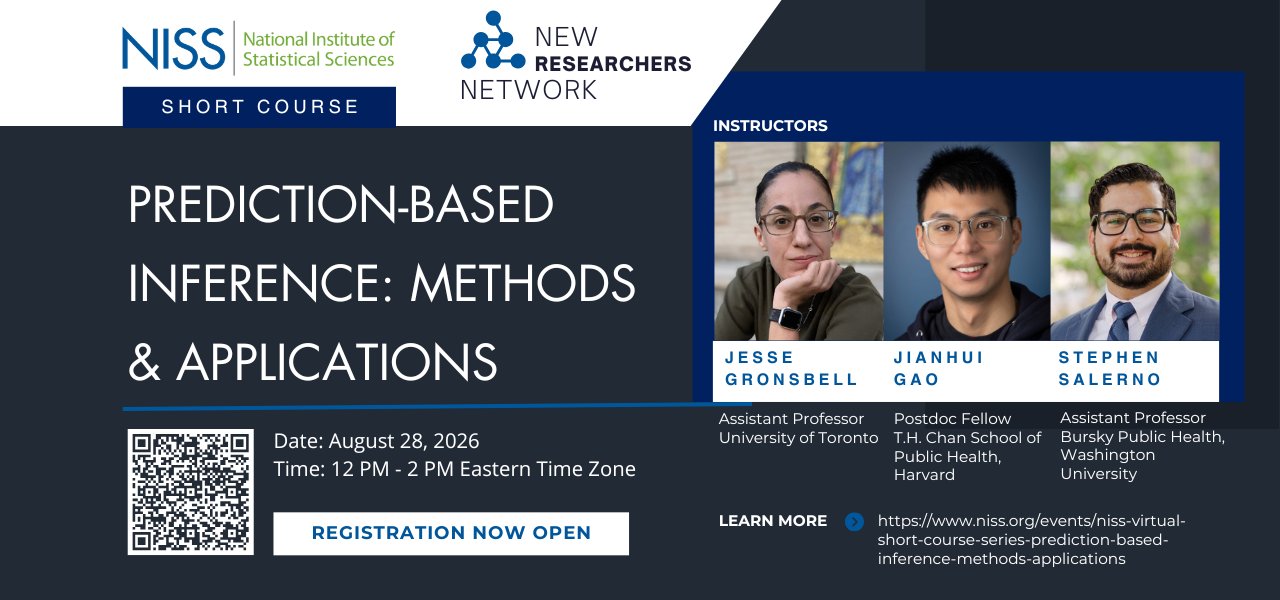
Instructors
- Jesse Gronsbell, PhD, University of Toronto
- Jianhu Gao, Postdoc Fellow, T.H. Chan School of Public Health at Harvard
- Stephen Salerno, PhD, Washington University in St. Louis
Registration
- $50 General Admission
- $25 NISS Affiliate Admission
- $25 Student Admission
Workshop Goals and Objectives
Learning Goals:
- Understand limitations in using predicted data for inference.
- Learn about methods that correct for bias and recover valid uncertainty estimates.
- Gain practical skills using the
ipdR package.
Learning Objectives:
- Explore data with AI/ML-predicted outcomes and diagnose bias/variance in predictions.
- Apply
ipd::ipd()to continuous and binary outcomes. - Interpret prediction-based (PB) inference outputs and visualize model results.
About the Instructors
Jesse Gronsbell is an Assistant Professor of Statistical Sciences at the University of Toronto. With a PhD in Biostatistics from Harvard University, where she was supported by a Ruth L. Kirschstein Predoctoral Individual National Research Service Award from the National Institutes of Health, her research focuses on the development of statistical methods for electronic health records and mobile health data. Her work has been recognized with a Young Researchers Award from the International Society of Nonparametric Statistics and an honorable mention for the Gertrude Cox Scholarship from the American Statistical Association. See Profile
Jianhui Gao was an essential member of the Ge-iSEE lab during his MSc studies in Biostatistics at the Dalla Lana School of Public Health, 2020-2021. As a student research assistant, he contributed to developing statistical models for the China-Bill Gates TB project, resulting in publications in Thorax and Science of the Total Environment. Jianhui was awarded the COVID-19 Student Engagement Award in recognition of his impactful research. He is now a Postdoc Fellow at T.H. Chan School of Public Health at Harvard. See Profile
Stephen Salerno develops statistical methods, machine learning tools, and open-source software for prediction, inference, and decision-making in clinical and public health research. His work sits at the intersection of biostatistics, artificial intelligence, and public health, with a focus on making statistical and AI/ML methods more accessible, interpretable, and useful for population health. Salerno’s research includes methods for drawing valid statistical inference from AI- and machine learning-generated outcomes, high-dimensional survival analysis, semi-competing risk prediction, selection bias, clinical quality measurement, and health policy. He applies these methods to cancer epidemiology, lung cancer survival, dialysis quality measures and other settings where complex data can inform care and public health systems. Salerno earned his PhD and master of science in biostatistics from the University of Michigan and his bachelor’s degree in biometry and statistics from Cornell University. His dissertation developed deep learning methods for correlated survival endpoints, motivated by the Boston Lung Cancer Study. He completed postdoctoral training in biostatistics at the Fred Hutchinson Cancer Center. He also contributes to data science education and public-interest data initiatives, including Statistics in the Community. See Profile
Getting Started with the Workshop Materials
This page is a quick checklist to help you get set up before the session. If you’d like to follow along interactively during the workshop, these steps will make sure everything runs smoothly.
Quick Checklist (10-15 minutes)
Complete these before the tutorial:
- Confirm you have a stable internet connection and a laptop.
- Choose your environment:
- Recommended: Docker + browser-based RStudio
- Alternative: local R/RStudio install
- Verify
ipdand core R packages install successfully (Option B only).
Prerequisites
You should be comfortable with:
- Base
Randtidyversesyntax (dplyr,ggplot2, basic pipes). - Basic regression modeling (
lm,glm). - Basic predictive modeling concepts (train/test split, predictions, model error).
Helpful but optional (for the supplemental modules):
- Bioconductor familiarity (
ExpressionSet,AnnotationDbi,MLInterfaces).
Software Requirements
Install Docker Desktop: Then run: Open: You need Install:
Option A (Recommended): Docker Workshop Environment
docker run -e PASSWORD=<your_chosen_password> -p 8787:8787 ghcr.io/salernos/ipd-workshop:latest
http://localhost:8787/rstudio, password = <your_chosen_password>
Option B: Local R + RStudio
R 4.4.1 or newer.
Event Type
- NISS Hosted