

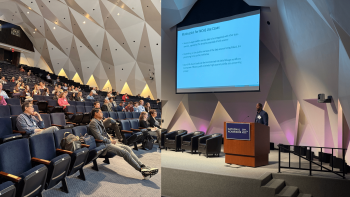
Date: April 30, 2026 | Location: National Academies of Sciences in Washington, D.C.
Event Page: AI Day for Federal Statistics 2026 | National Institute of Statistical Sciences
Leaders from federal statistical agencies, academia, and industry convened at the National Academies of Sciences, Engineering, and Medicine hosted by the Committee on National Statistics on April 30, 2026, for AI Day for Federal Statistics, a major gathering focused on how artificial intelligence is reshaping the nation’s statistical infrastructure. The event brought together experts to examine both practical applications and emerging challenges as federal agencies increasingly adopt AI-driven approaches to data collection, analysis, and dissemination.
Over the course of an afternoon packed with panels, breakout sessions, and a large poster exhibition, the program underscored a central theme: AI is no longer an experimental addition to federal statistics, but rather a technology that is quickly becoming foundational.
Opening Remarks Stress Urgency and Opportunity
The event opened with remarks from Katharine Abraham, chair of the Committee on National Statistics, who framed AI as both an opportunity and a responsibility for federal statistical agencies.
She emphasized that agencies must balance innovation with methodological rigor, particularly as public trust in official data remains paramount. With federal statistics underpinning economic policy, public health planning, and labor market analysis, the integration of AI tools must remain aligned with principles of transparency and accuracy.
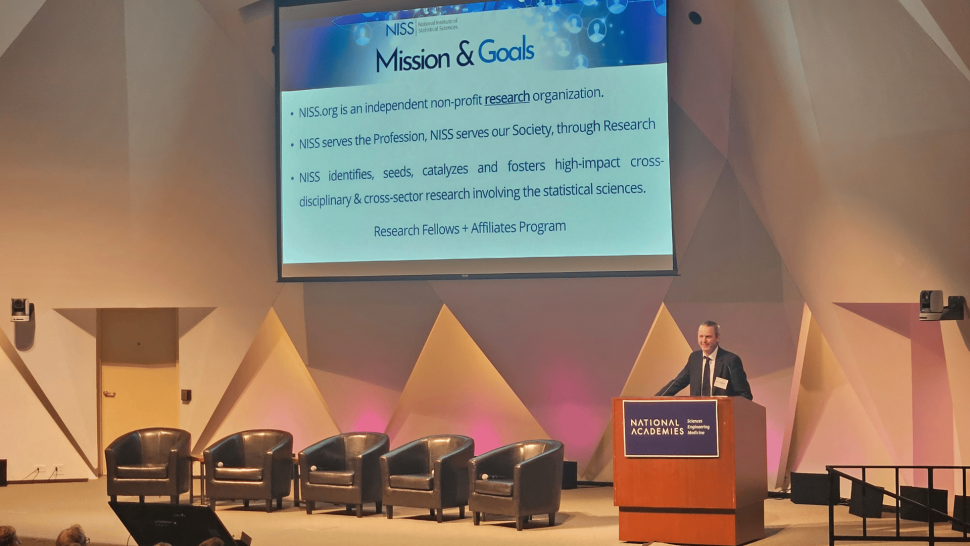
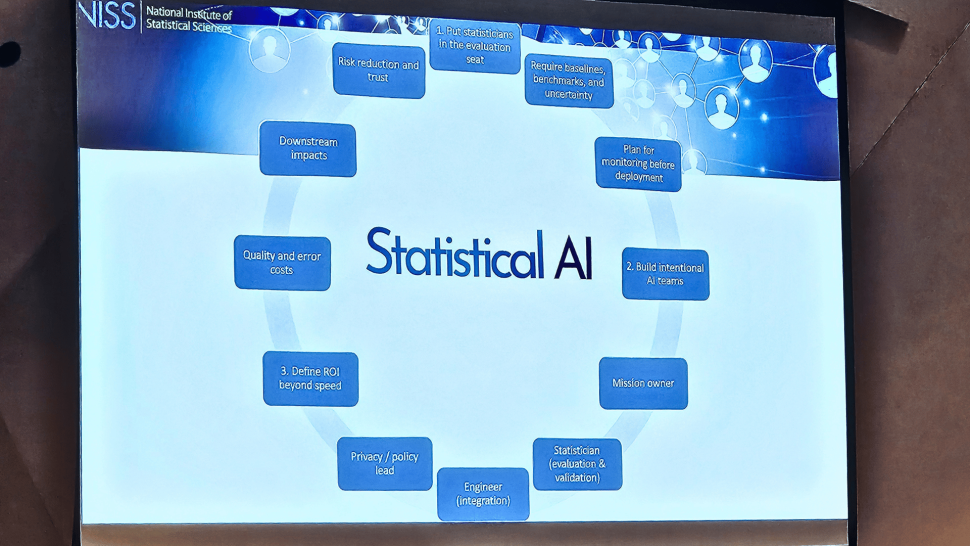
Following Abraham, David S. Matteson, director of the National Institute of Statistical Sciences, highlighted the evolving role of statisticians as leaders in AI development rather than passive adopters. His remarks pointed to growing interdisciplinary collaboration, where statistical expertise is essential for validating and guiding AI systems used in high-stakes federal applications.
Panel Explores Real-World Impact and ROI of AI
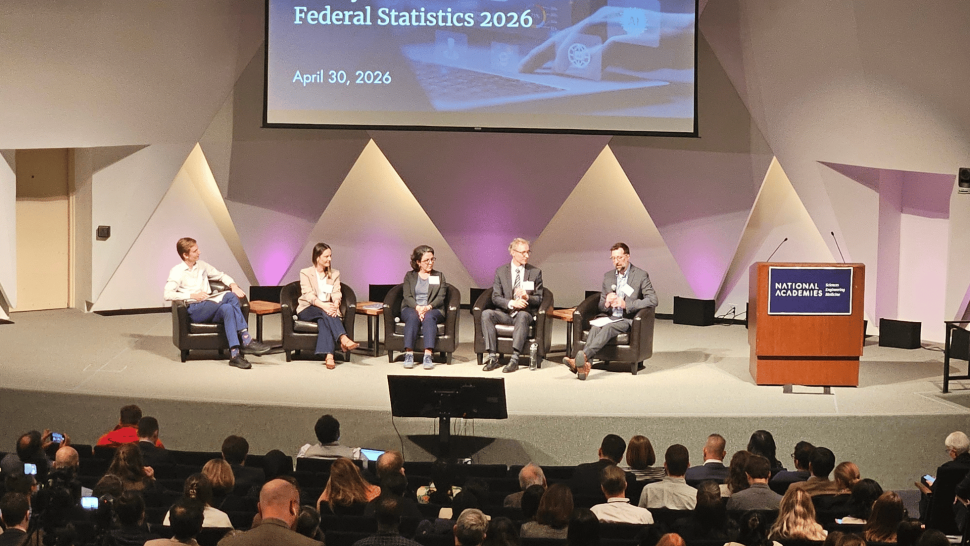
A central feature of the afternoon was the panel titled “Artificial Intelligence in Federal Statistics: Applications, Impacts, and ROI,” moderated by Federal Committee on Statistical Methodology Chair Robert Sivinski.
The panel brought together leaders from several agencies to illustrate how AI is already transforming operations:
- Benjamin Rogers (CDC) examined the return on investment of generative AI, emphasizing efficiencies gained in data processing and public health analytics.
- Kristina Gligorić (Johns Hopkins University) demonstrated how large language models (LLMs) can simulate survey responses, improve questionnaire design, and enhance sampling strategies while reducing costs.
- Lynda Laughlin (U.S. Census Bureau) traced the shift from legacy autocoding systems to LLM-based approaches for coding occupation and industry data, significantly improving text classification capabilities.
- Brian Quistorff (Bureau of Economic Analysis) explored long-term trends, highlighting how AI could reshape collaboration across agencies and redefine the statistical ecosystem.
Together, the panel painted a clear picture: AI adoption is delivering measurable gains in efficiency, scalability, and analytical power, but it requires careful implementation to ensure validity and fairness.
Breakout Sessions Dive Into Implementation Challenges
Following the panel, participants split into concurrent breakout sessions that focused on practical applications and technical challenges across a range of topics related to AI in federal statistics.
Governance and Responsible AI
One track centered on AI governance and implementation, featuring speakers such as Zach Whitman (GSA) and Gizem Korkmaz (Westat). Discussions explored the rollout of GSA’s USAi platform, which provides ready-to-use AI tools and services across federal agencies, as well as the importance of human oversight, documentation standards, and model validation. Speakers also emphasized the need to translate high-level ethical frameworks into actionable operational practices. Korkmaz highlighted that responsible AI must be grounded in principles such as transparency, fairness, and reproducibility, particularly in policy-driven environments.
AI-Ready Data
Another session focused on AI-ready data, addressing how agencies can prepare datasets for effective use with modern AI systems. Ramond Robinson (Bureau of Transportation Statistics) introduced a data transformation toolkit designed to improve metadata quality, manage missing data, and integrate diverse data sources. Brock Webb (Census Bureau) complemented this discussion by highlighting the real-world challenges of making government data accessible to AI systems, especially when dealing with complex or inconsistently structured datasets.
AI in Statistical Production
Sessions on AI in statistical production and workflow demonstrated how agencies are incorporating AI directly into their operational processes. Cordell Golden (National Center for Health Statistics) described how AI and machine learning are improving data linkage workflows, increasing both efficiency and analytical potential. A standout talk from NASA’s Rahul Ramachandran showcased the agency’s work on foundation models trained on large-scale scientific datasets, enabling new discoveries across areas such as climate science and space weather.
Software Modernization
Software modernization was another key theme, with presenters outlining efforts to update legacy systems and workflows. Amanda Lyndaker (Bureau of Economic Analysis) described initiatives to transition to modern, Python-based analytic environments, while Brian Quistorff shared how AI coding assistants are helping accelerate the shift away from outdated programming languages and tools.
Privacy, Security, and Ethics
Finally, discussions on privacy, security, and ethics underscored the importance of responsible AI use in environments handling sensitive data. Presentations examined privacy-enhancing technologies within the National Secure Data Service, as well as ongoing legal and ethical challenges under frameworks such as CIPSEA and FERPA. Speakers also raised concerns about emerging risks associated with generative AI, including issues related to data retention and supply chain vulnerabilities. Across sessions, a consistent message emerged: innovation must proceed without compromising confidentiality or public trust.
Poster Session Showcases Breadth of Innovation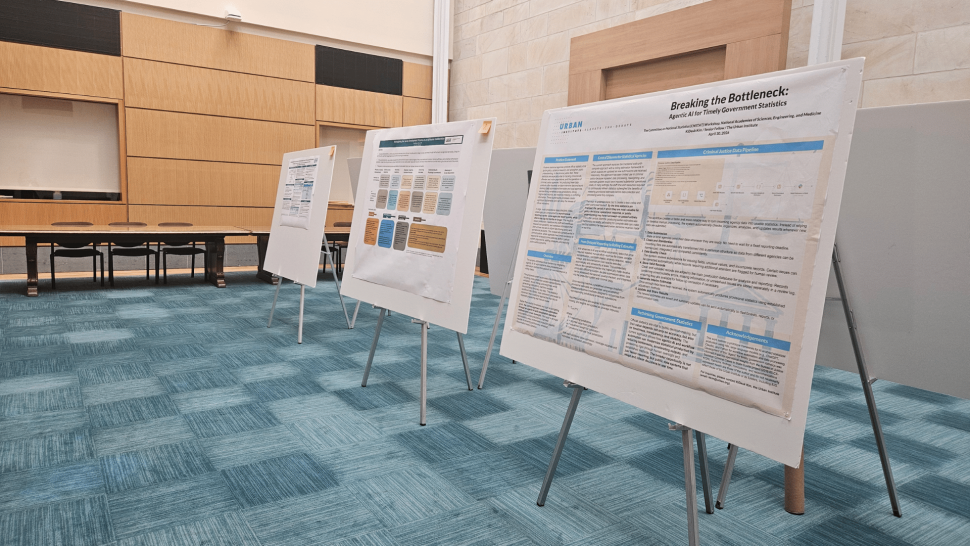
The event concluded with a large poster session and reception, featuring
dozens of projects from federal agencies, universities, and private organizations.
The posters illustrated the breadth of AI applications across federal statistics, including:
- AI-assisted survey translation and design
- Synthetic data generation using generative AI
- Employment projections and occupational analysis
- Privacy-preserving machine learning techniques
- Automated data cleaning and classification systems
Projects ranged from highly technical innovations—such as differential privacy frameworks and neural network models—to applied tools designed to streamline everyday workflows within agencies.
Notably, several posters focused on human-AI collaboration, signaling a shift away from viewing AI as a replacement technology toward a partner in statistical work.
A Turning Point for Federal Statistics
The discussions at AI Day 2026 revealed a field at a turning point. While AI adoption is accelerating, speakers consistently emphasized the need for:
- Strong governance frameworks
- Cross-agency collaboration
- Continued investment in workforce training
- Rigorous evaluation of AI outputs
The event also highlighted the evolving identity of statisticians, who are increasingly positioned as central contributors to AI development and oversight.
As federal agencies continue to modernize, AI is poised to play a critical role in shaping how data is collected, analyzed, and used for decision-making. Yet, as many speakers noted, the success of AI in federal statistics will ultimately depend on maintaining the credibility and reliability that define official data systems.
With robust participation and a wide array of perspectives, AI Day for Federal Statistics 2026 made clear that the integration of artificial intelligence into government data systems is not only underway—it is rapidly becoming essential.
View Recording of AI Day Sessions