
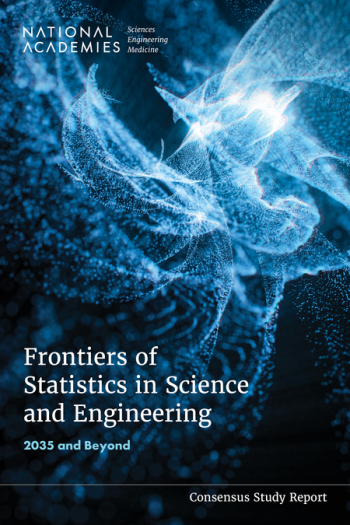
February 26, 2026 — The National Academies of Sciences, Engineering, and Medicine have released the prepublication version of a major Consensus Study Report, Frontiers of Statistics in Science and Engineering: 2035 and Beyond, offering an expansive roadmap for how statistical innovation will shape U.S. scientific leadership and economic competitiveness over the next decade. The report is now available for download via the National Academies Press.
The prepublication version of the report has been released and is now available for download: Frontiers of Statistics in Science and Engineering: 2035 and Beyond | The National Academies Press
The study, developed by an interdisciplinary ad hoc committee, delivers a forward‑looking assessment of the statistical sciences at a time when data-intensive research, AI-driven technologies, and complex global challenges demand unprecedented analytical capabilities. According to the National Academies, the committee examined emerging opportunities across statistics, data science, machine learning, engineering, and other allied fields to understand how statistical methods underpin discovery, innovation, and national competitiveness.
A key message echoed throughout the report is that statistical science remains foundational to nearly every scientific and technological domain. From advances in artificial intelligence and blockchain to precision agriculture, statistical thinking and methodology continue to drive progress across the U.S. economy. This message is central not only to the report itself but also to the public-facing events surrounding its release—including a dedicated webinar held February 26, 2026, where committee members highlighted core findings and answered questions from the scientific community.
A Vision for the Next Decade of Statistical Innovation
The report underscores the need for strategic investments in research, training, and interdisciplinary collaboration. The study identifies several priority areas expected to reshape the discipline:
-
Advances in AI and Machine Learning: The report highlights the statistical underpinnings of fast-evolving technologies such as deep learning, large language models, and hybrid computational systems. These areas will require rigorous statistical foundations for safe, effective, and responsible deployment.
-
Integration Across Disciplines: Statisticians increasingly collaborate across engineering, materials science, biomedical science, and computational fields. The report emphasizes that such cross-disciplinary engagement will be central to innovation and solutions addressing health, environmental, and security challenges.
-
Data-Intensive Scientific Discovery: With massive data streams emerging from sensors, simulations, and digital platforms, the need for statistically grounded methods to extract insight has never been more urgent.
-
Workforce Development: As highlighted by contributors to the study, a strong pipeline of statisticians and data scientists will be essential for sustaining U.S. leadership. This includes modernizing education and expanding opportunities for young researchers.
A Report with National Impact
Stakeholders across the scientific and policy landscapes are already responding to the report’s release. Members of the American Statistical Association, for example, noted the significance of the study for charting a strategic path for U.S. innovation and encouraged broad participation in the release webinar.
In addition to presenting findings, the report offers actionable recommendations for federal agencies, research institutions, and industry. These include aligning funding portfolios with emerging statistical challenges, supporting interdisciplinary research centers, and strengthening partnerships across sectors to accelerate the transition from statistical research to real-world application.
Looking Ahead
The release of Frontiers of Statistics in Science and Engineering: 2035 and Beyond marks a significant milestone for the field. With statistical science now integral to nearly every domain of modern life—from national security to medicine to advanced manufacturing—the report’s guidance is poised to shape policy, funding, and research priorities well into the next decade.
The prepublication version of the report is available through the National Academies Press.