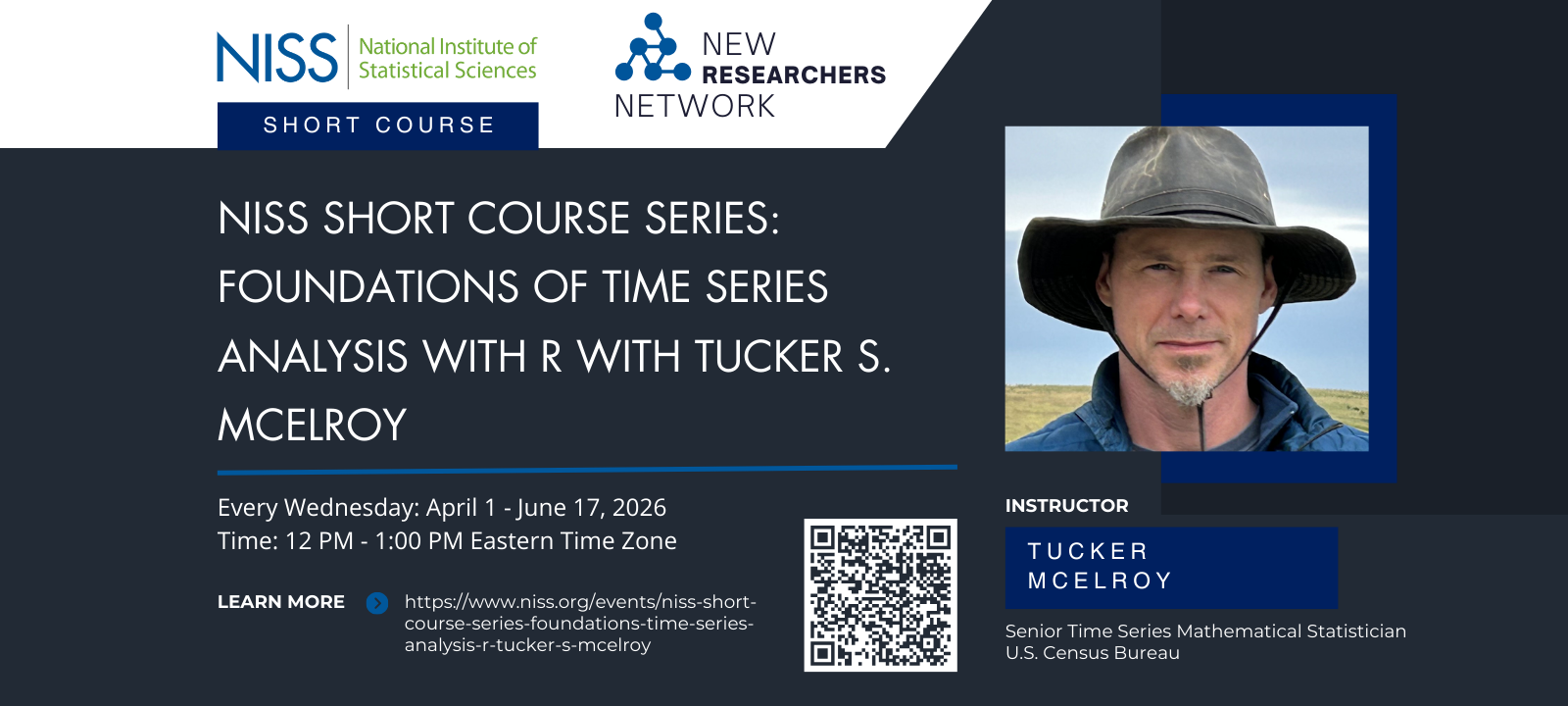
Wednesdays, April 1 - June 17, 2026 - 12:00pm to 1:00pm ET on Zoom
Register for this twelve‑week short course series led by Tucker S. McElroy, Senior Time Series Mathematical Statistician at the U.S. Census Bureau!
Overview
Across twelve one‑hour sessions, participants will walk through the full content of Time Series: A First Course with Bootstrap Starter, with each session dedicated to one chapter of the book. This series highlights the opportunity to engage in live, hands‑on R coding tutorials taught directly by the author himself.
Participants will implement each concept in real time as Tucker McElroy demonstrates methods, walks through examples, and offers practical insights based on more than two decades of experience in time series research. Attendees will also have the unique opportunity to ask questions during every session, making this course an exceptional chance to learn directly from one of the leading experts in the field.
Key Features
-
Explore edge cases and deepen conceptual understanding
-
Debug R code with real-time guidance
-
Learn fundamental time series topics, including: stationarity, autocorrelation, spectral analysis, filtering and forecasting
-
Gain exposure to non‑standard concepts such as: entropy, volatility filtering and time series bootstraps
-
Benefit from a blend of conceptual learning, author‑led coding, and live Q&A
-
Experience a practical, engaging, and accessible format ideal for those new to time series
Schedule
This series will run on Wednesdays, April 1 – June 17, 2026, from 12–1 pm ET.
Registration Details
Registration is handled through Eventbrite: https://www.eventbrite.com/e/niss-short-course-series-foundations-of-time-series-analysis-with-r-tickets-1984645091895?aff=oddtdtcreator
-
Full short course series purchase: $300
-
Individual short course ticket purchase: $35 each
-
Student Discounts: Individual short course ticket purchase: $25 or full short course: $250
-
NISS Affiliates: Please reach out to Megan Glenn (mglenn@niss.org) for your discount promo code. Ensure your email is through a valid affiliate institution. See our NISS Affiliates list here: NISS Affiliates | National Institute of Statistical Sciences

About the Instructor
Tucker S. McElroy is Senior Time Series Mathematical Statistician at the U.S. Census Bureau, where he has contributed to developing time series research and software for the last 22 years. He has published more than 100 papers, is a fellow of the American Statistical Association, and is a recipient of the Arthur S. Flemming award (2011). Visit GitHub Profile
Abstract
This short course series will cover the content of the book Time Series: A First Course with Bootstrap Starter in twelve sessions, each session covering a chapter. The course will be delivered to the National Institute of Statistical Sciences (NISS). The intended audience includes statisticians with little or no knowledge of time series, but a general knowledge of statistics. Prerequisites include a course on linear models, a course on mathematical statistics (such concepts as bias, variance, and the Gaussian distribution), and a familiarity with linear algebra (the transpose, inverse, and eigen-values of a matrix). The aim is to cover basic concepts of time series analysis at a level suitable for those with a bachelor's or master's degree in statistics, while including a few non-standard concepts such as entropy, volatility filtering, and time series bootstraps. A second aim is to incorporate coding in R of all concepts, methods, and examples.
VIsit Full Course Syllabus: GitHub - tuckermcelroy/BEwebinar: Materials for ASA Webinar sponsored by Business and Economics Section
The course will emphasize the methodological and computational aspects of the book's material. While the course will not include proofs, some important theoretical results will be discussed. The following outline provides the main topics; in italics are topics not typically covered in a time series course.
-
Introduction: time series data, cycles, regression, and autoregression
-
Stochastic Processes: stationarity, autocovariance, moving averages, white noise, and integrated processes
-
Filtering: linear filters, trends, and seasonality
-
Forecasting: prediction, normal equations, and iterative forecasting
-
ARMA: ARMA recursion, difference equations, and autocovariance generating functions
-
Frequency Domain: spectral density, frequency response functions, inverse autocovariances, and partial autocorrelations
-
Frequency Domain: discrete Fourier Transform, optimal filtering, Wold decomposition, and cepstrum
-
Model Identification: maximum entropy, time series entropy, and Kullback-Leibler discrepancy
-
Statistical Estimation: sample mean, sample autocovariance, spectral mean, and periodogram
-
Model Fitting: Gaussian likelihood, fitting AR and MA models, model assessment, and AIC
-
Nonlinear Time Series: GARCH processes, bi-spectral density, and volatility filtering
-
The Bootstrap: Monte Carlo, plug-in principle, model-based bootstrap, sieve bootstraps, subsampling, block bootstrap, stationary bootstrap, and model-free bootstrap
The teaching format is live and virtual. Webinars will be held weekly for one hour, with instruction being offered in real-time. The course will utilize R notebooks associated with the textbook. Each notebook corresponds to a lesson, covering a few examples or one concept, and occupying 5-10 minutes of time. Each one-hour webinar will cover 4-9 notebooks. The teacher will review that material in the lesson, explaining the main concepts. Students can execute the code on their own laptop, and then during instruction the instructor may modify the code; students can follow along and modify the code, or rewrite it, and in real-time see the new results. The notebooks are freely available on the Github site.
- Time Series Data
- Cycles
- Windows and Transforms
- Regression and Autoregression
- Random Vectors
- Stochastic Processes
- Stationarity
- Autocovariance
- Autoregression and Moving Average
- White Noise Processes
- Nonparametric Smoothing
- Linear Filters
- Examples of Filters
- Trends
- Seasonality
- Trend and Seasonality
- Integrated Processes
- Vector Space Geometry
- The L2 Space
- Projection in Hilbert Space
- Time Series Prediction
- Linear Prediction
- Orthonormal Sets
- Projection of Signals
- ARMA Recursion
- Difference Equations
- Causality of AR(1)
- Causality of ARMA
- Invertibility of ARMA
- Autocovariance Generating Function
- MA Representation
- Recursive Computation of Autocovariance
- Spectral Density
- Filtering in Frequency Domain
- Inverse Autocovariance
- Toeplitz Matrices
- Partial Autocorrelation
- AR and MA Identification
- Herglotz Theorem
- Discrete Fourier Transform
- Spectral Representation
- Optimal Filtering
- Kolmogorov's Formula
- Wold Decomposition
- Cepstrum
- Introduction to Entropy
- Entropy Mixing
- Maximum Entropy
- Time Series Entropy
- Markov Time Series
- Modeling via Entropy
- Kullback-Leibler Discrepancy
- Weak Dependence
- Sample Mean
- Serial Correlation
- Sample Autocovariance
- Spectral Means
- Periodogram
- Spectral Density Estimation
- Spectral Analysis
- MA Identification
- AR Identification
- Optimal Prediction Estimators
- Relative Entropy Minimization
- Computation of Optimal Predictors
- The Gaussian Likelihood
- Model Assessment
- Information Criteria
- Model Comparisons
- Iterative Forecasting
- Imputation and Signal Extraction
- Nonlinear Processes
- ARCH Process
- GARCH Process
- Bi-spectral Density
- Volatility Filtering
- Sampling Distributions
- Monte Carlo
- The Plug-in Principle and the Bootstrap
- Model-based Bootstrap
- Sieve Bootstraps
- Time Frequency Toggle Bootstrap
- Subsampling
- Block Bootstrap
Performance Objectives
Students will obtain a basic knowledge of time series theory and methodology. They will be able to analyze time series data by exploratory analysis, by model identification and fitting, and by making applications such as forecasting. Students will know how to use R to perform these tasks: not only to apply common time series functions appropriately, but also to write R scripts that capture time series methodology. In addition to learning basic time series topics, including ARMA modeling, students will learn how to use entropy, frequency domain methods, and time series bootstraps.
The course will be drawn from the textbook's material, but presentations will be primarily rendered through R Notebooks. The instructional strategy will be to briefly discuss a new topic, and then demonstrate through R code the computational and empirical facets of the topic. Short exercises can then be given, where the teacher asks the students to modify the R code to generate a different result. Through the technology of the virtual format, the instruction can be paused to address student questions.
About the NISS New Researchers Network

Event Type
- NISS Hosted
Cost
Full short course series purchase: $300
Individual short course ticket purchase: $35 each
NISS Affiliates: $25 individual; $250 full course series
Website
Location
Zoom
Policy