
Data-Science Leaders Convene to Bridge Public Health & Environmental Research
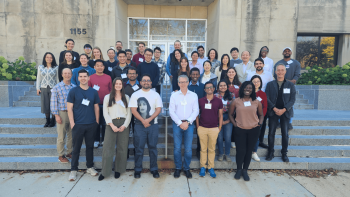
An interdisciplinary cohort of researchers gathered October 20–24, 2025 for the “Data Science at the Intersection of Public Health and the Environment" Ideas Lab, hosted jointly by the Institute for Mathematical and Statistical Innovation (IMSI) and the National Institute of Statistical Sciences (NISS), at IMSI's physical location within the University of Chicago. The workshop aimed to harness advanced statistical and data-science methods to better understand how environmental changes — including ecosystem disruption, pollution, extreme weather, and biodiversity loss — cascade into impacts on human health. Attendees included experts from statistics, epidemiology, environmental science, and related fields. See event page for full details: https://www.niss.org/events/data-science-intersection-public-health-and-...
The Ideas Lab was the result of nearly a year of planning by a dedicated steering committee who worked closely with IMSI staff to shape the workshop’s themes, structure, and collaborative design. The steering committee includes Bo Li (Washington University in St. Louis, SDS), Simone Gray (CDC/NCCDPHP/DCPC), Corwin Zigler (Brown Biostatistics), David S. Matteson (NISS & Cornell SDS), Dorit Hammerling (Colorado School of Mines, Applied Mathematics & Statistics), and Mevin Hooten (University of Texas at Austin, SDS). In the months prior to the event, they oversaw an open application process that attracted researchers from a wide range of backgrounds. All applications were reviewed jointly by the steering committee and IMSI staff to ensure a balanced, interdisciplinary cohort with diverse methodological expertise, domain insights, and perspectives. This extensive, year-long planning effort laid the groundwork for the highly interactive and intellectually rich environment that defined the Ideas Lab.
Prior to the Ideas Lab, the steering committee coordinated a two-hour Virtual Thought Summit on August 21, 2025, bringing together featured speakers Christopher K. Wikle (University of Missouri), Marianthi-Anna Kioumourtzoglou (Columbia University), and Jonathan Hobbs (Jet Propulsion Laboratory), with moderation by Bo Li (Washington University in St. Louis). The summit offered a high-level framing of the emerging challenges and opportunities at the intersection of environmental data science and public health, with each speaker sharing insights from their respective domains—ranging from Earth-system modeling to environmental epidemiology to remote-sensing innovation. Participants engaged in a moderated discussion that surfaced high-priority research themes, including novel inferential and causal-inference methods, co-modeling of environmental extremes, and strategies for integrating diverse datasets such as satellite imagery, biodiversity metrics, and health records. The perspectives and questions generated during this virtual session played a central role in shaping the agenda, priorities, and collaborative direction of the in-person Ideas Lab workshop held in October. See News Story for full details: Virtual Thought Summit Explores Data Science at the Intersection of Public Health and the Environment
Tackling Complex, Interconnected Challenges
Organizers emphasized that modern environmental and public-health crises — from climate-driven disasters to shifting biodiversity — demand novel, transdisciplinary approaches. Traditional siloed research can miss the already-intertwined dynamics between natural ecosystems and population health. The workshop’s “Ideas Lab” format was designed to spark new collaborations and research directions, rather than simply present final papers.
Participants explored a range of high-impact methodological areas.
-
New inferential methods that link diverse datasets (environmental monitoring, epidemiological studies, health registries) to uncover causal — not just correlational — relationships between environmental factors and health outcomes.
-
Models of species abundance and biodiversity over space and time, helping to reveal how shifts in ecosystems might affect environmental—and by extension, human—health.
-
Innovative sampling and data collection strategies to ensure representative, unbiased, and reproducible studies combining environmental and health data.
-
Co-modeling of extreme events (e.g., floods, wildfires, droughts, pandemics, food insecurity), to better anticipate and prepare for joint environmental and public-health crises.
-
Mathematical simulation of environmental systems — biological, physical, chemical — to explore tipping points and intervention scenarios, assessing how different policies or mitigation strategies could influence both ecosystem and human-health resilience.
A Collaborative, Forward-Looking Format
Rather than a traditional conference, the workshop was formatted as a working “ideas lab”: after the preliminary virtual “thought summit” in August 2025, participants spent five-plus days in intensive, in-person collaboration. The schedule included keynote talks, “provocateur” presentations, small-group brainstorming, and iterative working-group sessions. By the end, teams had begun formulating concrete research questions, writing plans, and exploring potential joint projects. The Ideas Lab is also expected to lead to extended activity: working groups, follow-up meetings, virtual events and short courses, poster sessions for early-career researchers, and potentially other research initiatives through the “CoLab” platform.
Why It Matters
As environmental crises such as climate change, biodiversity loss, pollution, and extreme weather intensify, the need for robust, data-driven insight into how these factors affect human health grows ever more urgent. By uniting data scientists, statisticians, epidemiologists, ecologists, and public-health experts, the workshop represents a bold effort to develop the tools and collaborative frameworks needed to understand — and ultimately influence — this complex interface.
The “Ideas Lab” model also signals a shift in how workshops are organized for the purpose of researchers to actively co-create future research pathways. If successful, this could accelerate the development of actionable science to inform policy, mitigate risk, and build resilience where environment and health intersect.
A Week of Collaboration: Inside the Ideas Lab
The five-day workshop unfolded in a carefully designed arc, progressing from trust-building to deep inquiry, and ultimately to the creation of concrete, interdisciplinary research teams.
Day 1: Building Trust, Sharing Stories, and Mapping the Landscape
The workshop opened with personal storytelling in triads, helping participants understand the diverse experiences, disciplines, and motivations represented in the room. Facilitators led an exercise on establishing community agreements, ensuring the week would unfold within a shared culture of respect, openness, and curiosity.
Participants then engaged in Mapping Our Collective Assets, an interactive process that visually connected their skills, methods, data sources, and domain interests. A presentation of pre-workshop survey results provided a snapshot of the group’s collective priorities. This set the stage for an energetic kinesthetic mapping activity, where participants physically moved through the space to cluster around problem areas, methodological tools, and data types.
The first Lightning Talks—three fast-paced, 15-minute presentations—gave researchers a chance to pitch compelling environmental and public-health challenges. A short divergent-thinking session pushed participants to reframe problems from multiple angles, generating bold possibilities.
Day 1 closed with a facilitator-led reflection and preview of Day 2, followed by optional social hour and reflection circles, where small groups processed insights and personal intentions for the week.
Day 2: Deepening the Conversation Through Provocations
Day 2’s core work centered on Provocations—thought-provoking presentations designed to challenge assumptions and broaden thinking around data, environment, and health. Participants heard three major provocations interspersed with four Lightning Talks, creating a rhythm of listening, questioning, and synthesizing. Each provocation explored a high-impact domain—ranging from complex environmental systems to health-equity implications of climate stressors.
During the Method–Problem Exploration, participants rotated through small groups to examine the provocations more deeply, identifying promising intersections between data-science tools and real-world environmental health challenges. The day closed with a facilitator wrap-up and a Social Network Questionnaire, allowing the organizers to understand how relationships and collaborations were already forming. An optional field trip and dinner offered an informal setting for continued connection-building.
Day 3: Seeds of Collaboration and the Ideas Exchange
Day 3 began with a reflection on the previous day and a preview of one of the workshop’s signature components: the Ideas Exchange. Before that, participants were challenged by two more provocations, each exploring complex intersections of environmental systems and public health. A short session titled “Data Are Essential But Not Everything” reminded attendees of the human, social, and ecological contexts in which data must be interpreted.
The Ideas Exchange functioned as a bustling marketplace of ideas, featuring multiple stations where participants pitched research concepts, datasets, methods, and problem domains. They circulated freely, identifying complementary expertise and forming “proto-groups” based on shared interest and interdisciplinary potential.
Afterwards, these emerging groups spent an hour crystallizing their ideas, followed by another series of Lightning Talks. The day ended with a facilitator-led closing circle, after which teams continued working informally into the evening.
Day 4: Building Teams, Deepening Questions, and Cross-Pollinating Ideas
Day 4 marked the transition from exploration to structured team development. After breakfast and reflection, facilitators introduced the concept of “study buddies”—experts available for targeted consultation.
Working groups spent the morning refining research questions, then met with their assigned study buddies for 30-minute consultations, receiving guidance on feasibility, data needs, and methodological frameworks. Additional Lightning Talks punctuated the day, continuously injecting fresh perspectives.
The Cross-Pollination Presentations invited each group to share early-stage ideas. In a rapid 5–7 minute format, six groups presented preliminary problem statements, methodological pathways, and potential impacts. The full cohort provided constructive, interdisciplinary feedback—an essential step in strengthening team direction.
Groups then spent the evening refining their proposals and preparing for the Friday showcase.
Day 5: Finalizing Research Teams and Preparing for Impact
The final morning centered on working group finalization. Teams established roles—including team lead and mentor—outlined 3-month milestones, confirmed communication channels, and polished their presentation decks.
A dedicated Q&A session with Dr. Zeng allowed participants to ask strategic questions about proposal development, evaluation criteria, and future opportunities.
The week culminated in public presentations and celebration, where each team delivered a 10-minute pitch outlining:
-
Why the problem matters
-
What they plan to investigate
-
How they will approach the work
-
Who is involved
-
When they will meet milestones
-
The Ask—what support or collaboration they need next
The closing celebration recognized the creativity, commitment, and collaborative energy that emerged throughout the week. With well-defined teams, project roadmaps, and growing cross-disciplinary networks, the Ideas Lab concluded not as an ending but as the launchpad for innovative research at the intersection of data science, public health, and the environment.