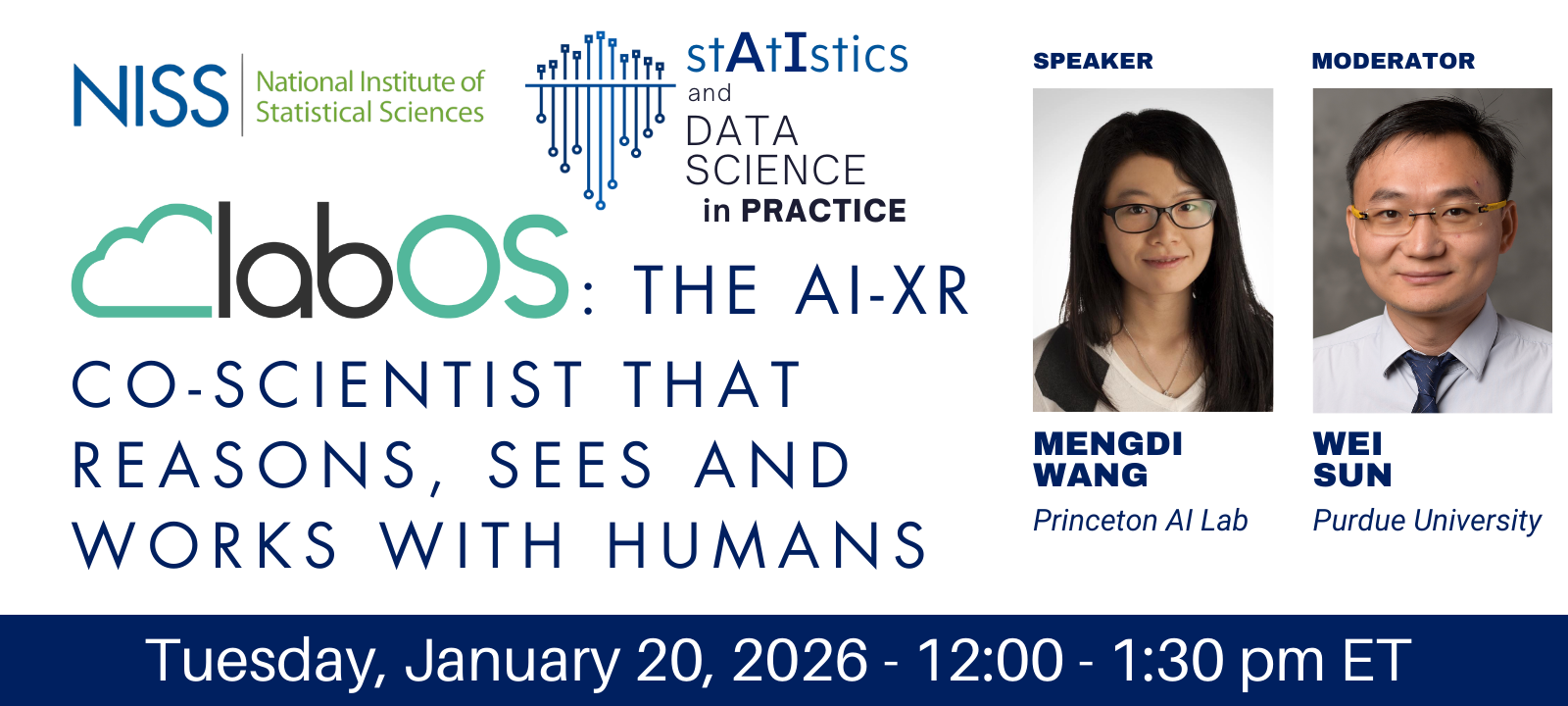
Speaker
Mengdi Wang, Director of Princeton AI for Accelerating Invention, Princeton AI Lab, Princeton University
Moderator
Abstract
Talk Title: LabOS: The AI-XR Co-Scientist That Reasons, Sees and Works With Humans
Modern science advances fastest when thought meets action. LabOS represents the first AI co-scientist that unites computational reasoning with physical experimentation through multimodal perception, self-evolving agents, and Extended-Reality(XR)-enabled human-AI collaboration. By connecting multi-model AI agents, smart glasses, and robots, LabOS allows AI to see what scientists see, understand experimental context, and assist in real-time execution. Across applications -- from cancer immunotherapy target discovery to stem-cell engineering and material science -- LabOS shows that AI can move beyond computational design to participation, turning the laboratory into an intelligent, collaborative environment where human and machine discovery evolve together.
About the Speaker
 Mengdi Wang is Co-Director of Princeton AI for Accelerated Invention, and Professor of the Department of Electrical and Computer Engineering and the Center for Statistics and Machine Learning at Princeton University. She is also affiliated with the Department of Computer Science, Omenn-Darling Bioengineering Institute, and Princeton Language+Intelligence. She was a visiting research scientist at Google DeepMind, IAS and Simons Institute on Theoretical Computer Science. Her research focuses on machine learning, reinforcement learning, generative AI, large language models, and AI for science. Mengdi received her PhD in Electrical Engineering and Computer Science from MIT in 2013. Mengdi received the Young Researcher Prize in Continuous Optimization of the Mathematical Optimization Society in 2016 (awarded once every three years), the Princeton SEAS Innovation Award in 2016, the NSF Career Award in 2017, the Google Faculty Award in 2017, and the MIT Tech Review 35-Under-35 Innovation Award (China region) in 2018, WAIC YunFan Award 2022, American Automatic Control Council's Donald Eckman Award 2024. Find out more about her at: https://mwang.princeton.edu/
About the Moderator
 Wei Sun is an Associate Professor of Quantitative Methods at Purdue University's Mitchell E. Daniels, Jr. School of Business, with a courtesy appointment in the Department of Statistics. He serves as the PhD Coordinator for Quantitative Methods and is recognized for his expertise in statistical foundations of large language models, trustworthy reinforcement learning, tensor data analysis. Dr. Sun's research has been supported by notable grants from the National Science Foundation and the Office of Naval Research. Dr. Sun earned his Ph.D. in Statistics from Purdue University in 2015. Before that, he was a research scientist at Yahoo Labs and an assistant professor at Miami Business School. Dr. Sun is on the editorial board for Annals of Applied Statistics, Statistical Analysis and Data Mining. See Profile
About AI, StAtIstics and Data Science in Practice
The NISS AI, Statistics and Data Science in Practice is a monthly event series brings together leading experts from industry and academia to discuss the latest advances and practical applications in AI, data science, and statistics. Each session features a keynote presentation on cutting-edge topics, where attendees can engage with speakers on the challenges and opportunities in applying these technologies in real-world scenarios. This series is intended for professionals, researchers, and students interested in the intersection of AI, data science, and statistics, offering insights into how these fields are shaping various industries. The series is designed to provide participants with exposure to and understanding of how modern data analytic methods are being applied in real-world scenarios across various industries, offering both theoretical insights, practical examples, and discussion of issues.
During Spring 2026, from January through May 2026, the series will focus on large language models (LLMs) and the statistical and methodological foundations required to develop, evaluate, and deploy them responsibly and effectively. As LLMs become central to a wide range of scientific, industrial, and societal applications, careful attention to data generation, model training, evaluation, and inference is essential to ensure reliability, robustness, and transparency. As LLMs become increasingly central to scientific research, industry workflows, and societal decision-making, rigorous attention to how training data are constructed, curated, and sampled is critical for understanding model behavior and limitations. The series will highlight methodological considerations in model training and fine-tuning, including sources of bias, variability, and uncertainty, as well as principled approaches to benchmarking and evaluation that move beyond surface-level performance metrics. Emphasis will be placed on transparent and reproducible evaluation frameworks that support meaningful comparisons across models and use cases, and on statistical perspectives that help clarify what LLM outputs do and do not represent. By grounding discussions of LLM development and deployment in sound statistical reasoning, the series aims to promote more reliable, interpretable, and trustworthy language models in practice.
Featured Topics:
- Veridical Data Science - Speaker: Bin Yu, October 15,2024
- Random Forests: Why they Work and Why that’s a Problem - Speaker: Lucas Mentch, November 19, 2024
- Causal AI in Business Practices - Speakers: Victor Lo, and Victor Chen, January 24, 2025
- Large Language Models: Transforming AI Architectures and Operational Paradigms - Speaker: Frank Wei, February 18, 2025
- Machine Learning for Airborne Biological Hazard Detection - Speaker: Jared Schuetter, March 11, 2025
- Trustworthy AI in Weather, Climate, and Coastal Oceanography - Speaker: Dr. Amy McGovern, May 13, 2025
- Sequential Causal Inference in Experimental or Observational Settings - Speaker: Aaditya Ramdas, August 26, 2025
- Covariate Adjustment, Intro to Resampling, and Surprises - Speaker: Tim Hesterberg, October 3, 2025
- Bayesian Geospatial Approaches for Prediction of Opioid Overdose Deaths Utilizing the Real-Time Urine Drug Test - Speaker: Joanne Kim, November 18, 2025
- COVID-19 Focused Cost-benefit Analysis of Public Health Emergency Preparedness and Crisis Response Programs - Speaker: Nancy McMillan, December 11, 2025
Event Type
- NISS Hosted
Cost
Website
Location
Policy